'%3E%3Cpath d='M49.7985 19.9686L40.9118 4.82572C40.5043 4.13149 39.6131 3.89604 38.9161 4.29857L33.5901 7.37348L28.7928 5.60893C27.2924 5.05707 25.6377 5.19897 24.2532 5.99838L16.9684 10.2043L10.5101 6.47553C10.1667 6.27729 9.75782 6.2268 9.37638 6.33529C8.99513 6.44389 8.67413 6.70229 8.48673 7.0518L0.174133 22.5499C-0.199695 23.2471 0.0474732 24.1154 0.732629 24.5109L4.03116 26.4154L2.37697 29.2805C1.16534 31.379 1.88693 34.0719 3.98546 35.2835C4.95949 35.8458 6.06134 35.9912 7.0839 35.7762C7.409 36.7692 8.08576 37.6509 9.05978 38.2132C10.0338 38.7755 11.1357 38.9208 12.1582 38.7059C12.4833 39.6989 13.1601 40.5806 14.1341 41.1429C15.1081 41.7052 16.21 41.8505 17.2325 41.6356C17.5577 42.6287 18.2345 43.5103 19.2085 44.0726C21.307 45.2842 23.9999 44.5626 25.2115 42.4641L25.4008 42.1363L30.898 45.3101C32.9965 46.5217 35.6894 45.8001 36.901 43.7016C37.1869 43.2063 37.3639 42.6778 37.4418 42.1436C39.3109 42.6359 41.356 41.8448 42.3678 40.0921C42.7162 39.4886 42.9039 38.8359 42.9458 38.1834C44.5448 38.2673 46.1349 37.4735 46.9889 35.9943C47.8429 34.5151 47.7354 32.7412 46.8632 31.3983C47.4073 31.0358 47.8787 30.5468 48.2272 29.9433C49.4053 27.9028 48.7552 25.3007 46.7891 24.0445L49.4658 21.8409C50.022 21.3832 50.1629 20.5895 49.7985 19.9686ZM25.7181 8.53559C26.3474 8.17211 27.0992 8.10775 27.7816 8.35863L33.2228 10.36C33.631 10.5101 34.0843 10.4711 34.4608 10.2538L39.1213 7.56303L46.6391 20.3735L44.0841 22.4769L26.4898 12.3187C26.0365 12.057 25.4781 12.057 25.0249 12.3187L16.9272 16.9939C16.2532 17.4016 15.3058 17.1478 14.9262 16.4578C14.5185 15.784 14.7724 14.8363 15.4623 14.4568L25.7181 8.53559ZM5.4504 32.7463C4.75089 32.3424 4.51036 31.4449 4.91427 30.7454L7.35568 26.5167C7.75958 25.8172 8.65714 25.5767 9.35665 25.9806C10.0562 26.3845 10.2967 27.2821 9.89279 27.9816L7.45138 32.2102C7.04757 32.9097 6.14991 33.1502 5.4504 32.7463ZM10.5247 35.676C9.82521 35.2721 9.58468 34.3746 9.98859 33.675L13.4066 27.7549C13.8105 27.0553 14.708 26.8149 15.4075 27.2188C16.107 27.6227 16.3476 28.5203 15.9437 29.2198L12.5257 35.1399C12.1219 35.8394 11.2242 36.0799 10.5247 35.676ZM15.599 38.6057C14.8995 38.2018 14.659 37.3042 15.0629 36.6047L17.5043 32.3761C17.9082 31.6766 18.8058 31.4361 19.5053 31.84C20.2048 32.2439 20.4453 33.1414 20.0414 33.841L17.6 38.0696C17.1962 38.7691 16.2986 39.0096 15.599 38.6057ZM20.6734 41.5355C19.9739 41.1316 19.7333 40.2339 20.1372 39.5344L21.6021 36.9972C22.006 36.2977 22.9036 36.0572 23.6031 36.4611C24.3026 36.865 24.5432 37.7625 24.1393 38.4621L22.6744 40.9993C22.2706 41.6989 21.3731 41.9394 20.6734 41.5355ZM44.452 34.5294C44.0481 35.2289 43.1505 35.4695 42.451 35.0656L34.8395 30.671C34.1389 30.2665 33.243 30.5066 32.8385 31.2072C32.434 31.9078 32.674 32.8037 33.3746 33.2081L39.2946 36.6261C39.9942 37.03 40.2347 37.9276 39.8308 38.6271C39.4269 39.3266 38.5293 39.5671 37.8298 39.1632L31.9098 35.7453C31.2092 35.3408 30.3133 35.5808 29.9088 36.2814C29.5043 36.982 29.7443 37.8779 30.4449 38.2824L33.8278 40.2355C34.5274 40.6394 34.7679 41.537 34.364 42.2365C33.9601 42.936 33.0625 43.1765 32.363 42.7726L26.8508 39.5901C27.807 37.5482 27.0561 35.0714 25.0681 33.9237C24.4646 33.5752 23.8118 33.3874 23.1593 33.3456C23.2432 31.7465 22.4494 30.1565 20.9702 29.3024C20.3667 28.9539 19.714 28.7663 19.0615 28.7244C19.1454 27.1253 18.3516 25.5353 16.8724 24.6813C15.3932 23.8273 13.6193 23.9348 12.2765 24.807C11.914 24.2628 11.425 23.7914 10.8215 23.443C9.13243 22.4678 7.059 22.7458 5.68214 23.9853L3.42706 22.6836L10.3541 9.7685L14.0387 11.8958L13.9975 11.9197C12.981 12.5066 12.2538 13.4542 11.9499 14.588C11.6462 15.7218 11.8021 16.9061 12.389 17.9226C12.9759 18.9391 13.9235 19.6663 15.0573 19.9702C16.1911 20.2738 17.3754 20.118 18.3919 19.5311L25.7572 15.2788L45.1539 26.4776C45.8534 26.8815 46.094 27.779 45.6901 28.4786C45.2861 29.1781 44.3886 29.4186 43.6891 29.0147L37.7691 25.5967C37.0685 25.1922 36.1726 25.4323 35.7681 26.1329C35.3636 26.8334 35.6036 27.7293 36.3042 28.1338L43.9157 32.5284C44.6153 32.9323 44.8559 33.8299 44.452 34.5294Z' /%3E%3C/g%3E%3Cdefs%3E%3CclipPath id='clip0_234_12939'%3E%3Crect width='50' height='50' fill='white'/%3E%3C/clipPath%3E%3C/defs%3E%3C/svg%3E)
How to Choose a Conference Venue: A Step-by-Step Guide
Choosing a conference venue means finding a space that suits the format of your event. That means a main room that fits your audience, enough breakout space, the technology your sessions depend on, and a location attendees can reach easily. The venue affects attendance, the quality of sessions and a large share of the budget, so it is usually the first major decision in conference planning. This guide walks through the selection process step by step and ends with a checklist you can use when comparing conference venues.
What makes a good conference venue?
A good conference venue is chosen for the event’s format, and the headcount is only one part of that. It has a main room for plenary sessions, separate spaces for breakouts and catering, reliable technology and easy access for every attendee. An experienced venue team also helps the day run smoothly.
Capacity needs checking in the layout you plan to use, because a room’s maximum figure rarely applies to every set-up. Access covers transport links, parking and step-free entry. The terms should be clear as well: transparent pricing and a contract that reflects what you agreed.
What is venue sourcing?
Venue sourcing is the structured process of finding, comparing and securing a venue for an event. Professional event planners usually send a brief or request for proposal (RFP) to a shortlist of venues and compare the responses. They then visit the strongest options and negotiate terms before signing. A smaller conference goes through the same steps in a lighter form.
You will also see the term venue selection. It refers to the decision itself: picking the final venue from the options you sourced. The steps below cover both.
How to choose a conference venue: the short version
- Define the conference format and requirements.
- Choose the location.
- Decide on the type of conference venue.
- Check the spaces and layouts.
- Assess the technology and conference facilities.
- Compare costs and what is included.
- Visit the venue.
- Review the contract and book.
Step 1: Define the conference format and requirements
The programme comes first. The number of sessions, how attendees move between them and whether anyone joins remotely all decide which spaces you need. A clear brief also makes venue responses easier to compare.
Your brief should cover:
- the maximum realistic number of attendees, including speakers, staff and exhibitors
- the sessions: plenaries for everyone, parallel breakouts, workshops or panels
- whether the conference runs for a single day or several
- extra spaces for registration, exhibition stands, catering and networking
- whether participation is fully in person or hybrid
Capacity depends on how each room is set up, so a headcount alone is not enough. Our guide to room size and capacity explains how to work out the space each session needs. For smaller internal events, such as a leadership strategy day, our guide to planning a corporate offsite may be a closer fit.
Step 2: Choose the location
The right location is easy for most attendees to reach and suits the character of the event. A city-centre venue near major transport links works well for conferences with many local or day attendees. A quieter setting can suit multi-day programmes where attendees stay together.
Look at how close the venue is to rail, metro and airports for anyone travelling in, and whether there is parking on site or nearby. Every conference space should have step-free access, accessible toilets and clear signage. For multi-day conferences, or attendees coming from other cities, check for accommodation nearby. Restaurants and spaces for informal networking after sessions are worth noting too.
Step 3: Decide on the type of conference venue
Different types of venue suit different conference formats. Narrowing down the type early saves time, because each one packages space, services and pricing differently.
| Venue type | Best for | Consider |
|---|---|---|
| Conference centre | Large and multi-session conferences | Number of rooms, on-site event staff, exhibition space |
| Conference hall | Seminars and presentations to a large audience | Stage, PA system, sightlines from every seat |
| Conference room in a business centre | Small conferences and executive briefings | Breakout options, catering arrangements |
| Event space | Conferences with networking, launches or receptions | Flexibility of set-up, AV, catering |
| University or academic venue | Academic and professional conferences | Availability outside term time, lecture theatre facilities |
| Unique venue (museum, gallery) | Conferences where atmosphere matters | Restrictions on set-up, access times, AV |
Small conference venues, such as a conference room in a business centre, are often the most practical choice for internal conferences and specialist seminars. If you are unsure which type of space fits your programme, compare a meeting room, conference room or event space first.
Most conference venues offer their spaces through conference room rental, also called conference room hire or conference venue hire, by the hour, half-day or full day.
Step 4: Check the spaces and layouts
A conference uses several spaces at once. Attendees spend time in registration, at breaks and in breakout sessions as well as in the main hall, and crowded or badly connected spaces disrupt the programme.
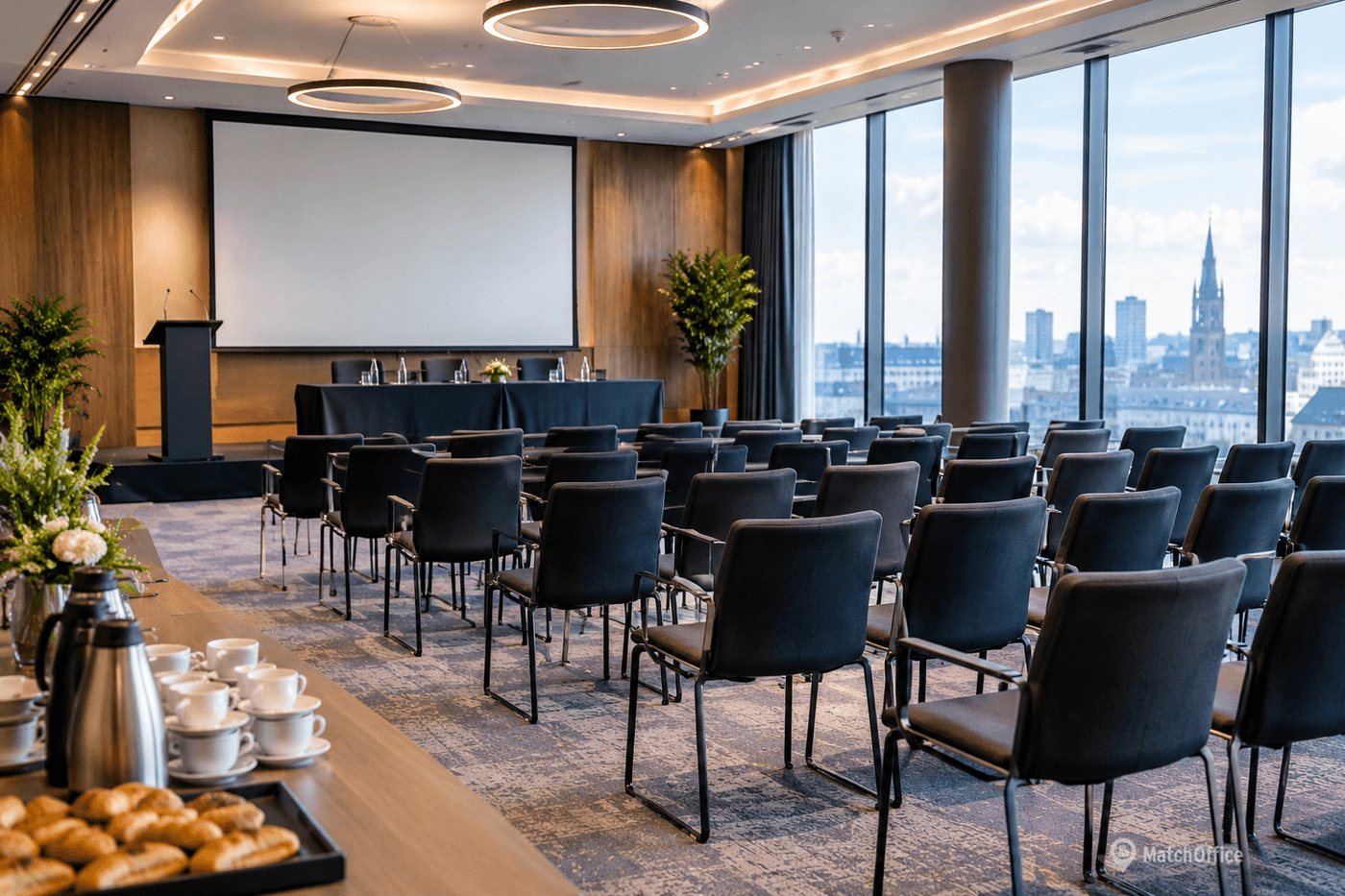
In the main room, check capacity in your planned layout, the ceiling height and the sightlines to the stage and screens. You need enough breakout rooms for parallel sessions, close to the main room. Registration needs space to welcome people without blocking the entrances. Catering and networking areas work best when they are separate from session rooms, so breaks do not require a room reset. If sponsors or exhibitors are attending, confirm there is exhibition space.
The layout changes how many people a room holds and how they interact. Theatre style suits keynotes, classroom style suits training, and cabaret style suits group work. See our guide to meeting room layouts for the strengths of each set-up.
Step 5: Assess the technology and conference facilities
Technology failures are among the most visible problems at a conference. Confirm what is installed, what can be added and who will support it on the day.
Things to confirm with the venue:
- projectors or screens, microphones and a PA system suited to the room size
- lighting and space at the front for speakers and panels
- Wi-Fi that can handle every attendee connecting at once
- streaming and recording, if sessions will be broadcast or shared afterwards
- cameras and audio that let remote attendees follow and take part in a hybrid conference
- a dedicated technician during the event
Ask the venue to list its conference facilities in writing, so you know what the quote covers.
Step 6: Compare costs and what is included
The base price of a conference venue rarely reflects the full cost. Compare quotes for the same programme, and check which services each venue includes and which it charges separately.
A typical quote is built from room hire or rental for the main room and each breakout room, plus catering for refreshments, lunch and any evening reception. Technology adds AV equipment, streaming and technical support. Staffing can cover event coordination, security and registration. Some venues charge for early access to set up and for time to clear down, and taxes and service fees may or may not be included in the quoted price.
For a detailed breakdown of inclusions and extras, see our guide to what conference room rental includes. For an example of how venue prices vary between cities, see our guide to meeting room rental costs in the US.
Step 7: Visit the venue
A site visit, also called a site inspection, shows you how the spaces connect, how the main room sounds and how attendees will move through the building. Visit your shortlisted venues before you sign, ideally at a similar time of day to your event.
On the visit, walk the route from the entrance to registration, the main room and the breakout rooms. Test the AV and Wi-Fi in the rooms you plan to use, and listen for noise between rooms and from outside the building. Meet the person who will coordinate your event on the day, and ask whether any other events are booked at the venue on the same date.
Step 8: Review the contract and book
The venue contract should reflect everything agreed during sourcing. Read it in full before signing, and ask for any verbal agreements to be added in writing.
Make sure the contract covers:
- every room, the access times and the agreed layouts
- the catering, technology and staffing included in the price
- the deposit, payment schedule and final balance
- cancellation deadlines and charges if the event is moved or cancelled
- how far attendance can change, and by when, without penalty
- responsibility for damage and for third-party suppliers
For the full booking process, from defining your needs to confirming the room, see our step-by-step guide on how to rent a meeting room.
Conference venue checklist
Use this checklist when comparing conference venues:
- Main room capacity confirmed for the planned layout
- Enough breakout rooms close to the main room
- Space for registration, catering and networking
- Exhibition space, if needed
- Transport links, parking and step-free access checked
- Accommodation nearby for travelling attendees
- AV, PA system and stage suited to the main room
- Wi-Fi capacity for all attendees
- Streaming or hybrid set-up, if needed
- Technical support during the event
- Itemised quote with all inclusions and extras
- Site visit completed
- Contract reviewed, including cancellation and attendee number terms
Find conference venues on FindMeetingRooms
FindMeetingRooms lists conference halls, conference rooms, meeting rooms and event spaces in cities across Europe, North America, Asia, the Middle East, Africa, Australia and South America. You can compare conference venues by location, capacity and facilities, then contact them directly to request quotes for your programme. Choose your country to start your search.